Our July e-newsletter
Inside
this issue:
- The George Morlan Story
- New Cabinetry Showroom Opens in the Pearl District
- Trade Secrets
- Shop Talk
- Events Calendar
- Our Digital Libraries


Inside
this issue:
Inside
this issue:
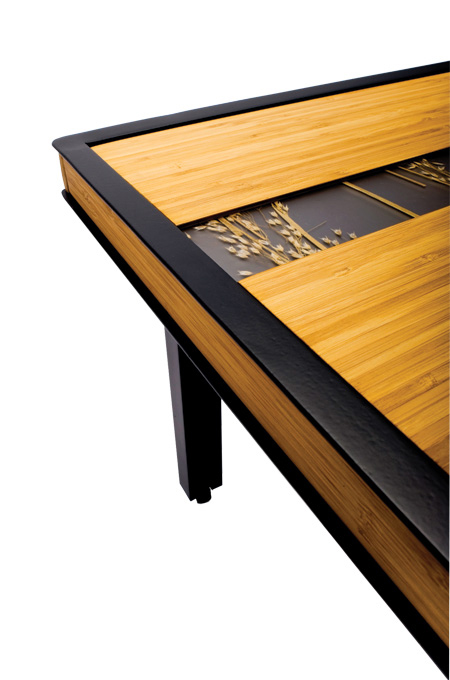
When furnituremaker Bill More left Brooklyn, N.Y. and headed west on a train, the trip had an unexpected result. “I met my wife on that train,” he says. “She got on in Wisconsin, and neither of us got off until the train arrived in Portland.”
More grew up in New Jersey, where school sparked an interest in building things. “I liked classes like shop where they’d give you tools and just let you work with them,” he says.
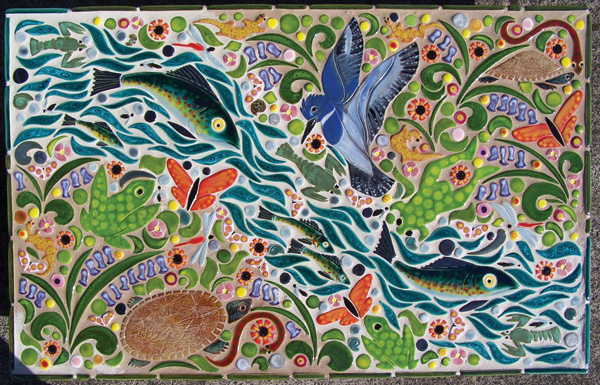
Washram, Wash.-based mosaic artist Toms Royal became interested in tile when he owned a pottery-painting studio in Portland. “We began to offer classes in mosaics, so I had to learn how to do it,” he says. “I discovered that I enjoyed the medium and that it was a way to use my theories about design.”
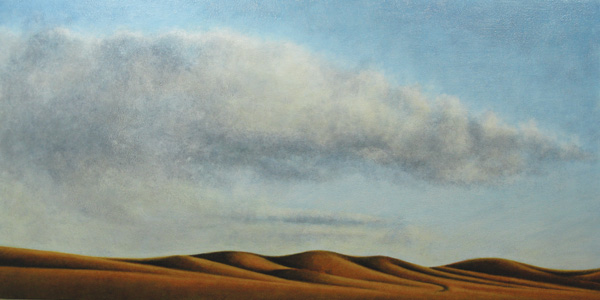
A former figurative painter, Catherine J. Lee began to enjoy her art even more after she began depicting landscapes. “When you’re painting or drawing figures, you’re almost always inside,” she says. “I really enjoy being outside, so landscape painting lets me paint—and be outside.”
Architectural metalworker Joseph Mross specializes in custom, hammered-copper kitchen and fireplace hoods done in an Arts & Craft-style, but he’s made all sorts of other things, too. “I’ve done light fixtures, awnings, doors and even a hammered-pewter entertainment center,” he says. “Once, I was asked to make a forged basketball hoop.”
Roger Thomas’ work could be called experimental: His best pieces usually begin as “test” projects for new fusing techniques, he’s often unable to see what his designs will look like before they’re kiln-fused and he leaves the interpretation to his viewers. Practicing Balance (below), a piece built of glass remnants from another work, is a perfect example. “Practicing Balance is one of my best accidents and definitely one of my favorite pieces,” he says. “When you look at it, you think it’s a landscape until you start looking for the usual signals of what a landscape is,” he says. “They’re here, but none of them quite make sense. Vertical lines trigger your brain to think, Oh, those are trees! I’m providing you with so little information that your mind is doing all the work in this piece. And that’s what I want: for my pieces to be abstract until you decide they’re a landscape.”
Think tile is boring (like sterile white shower tiles or machine-made floor squares)? Think again. Bob and Iris Jewett, the creative forces behind Wilburton Pottery, a Bellevue, Wash., ceramics company, hand-make tiles that could (and often do) double as works of art. With more than 500 designs (including people, animals, fruit, fairies and regional natural features such as Mount Hood) and hundreds of border options, these tiles are truly treasures. “Because all of our tiles are handmade, no two are exactly alike,” says Iris. “And we’re interested in so many different things that we’re always getting new design ideas—from art books, customer requests and from nature. We live across the street from a 100-acre park, and Bob goes there to sketch.”
Spokane, Wash., painter Lanny DeVuono’s pieces are a twist on traditional landscapes: She uses boxes as canvases, wrapping the painting over five sides, and chooses industrial scenes (think powerlines and factories) rather than bucolic ones. But she does have a common thread with the original landscape painters. “In the 19th century, painting landscapes was a way to romanticize the loss of nature to the Industrial Revolution,” says DeVuono. “That’s relevant today. When I drive to work every day, I see development eating up land.”
Sure, Barbara Chen’s smiling, dancing women are plump and cast of heavy bronze, but these fleshy figures look decidedly light-stepping. The Richland, Wash., sculptor credits that to a freewheeling imagination (she pictures poses in her mind rather than using plus-sized models) and a constant stream of music (“I listen to everything from ballet to reggae, world music to opera, and that inspires the feel of their poses,” she says). But more than anything, Chen’s work is a product of happiness. “For me, making art is like making music,” she says. “I want it to be something that I enjoy and that other people can enjoy.”